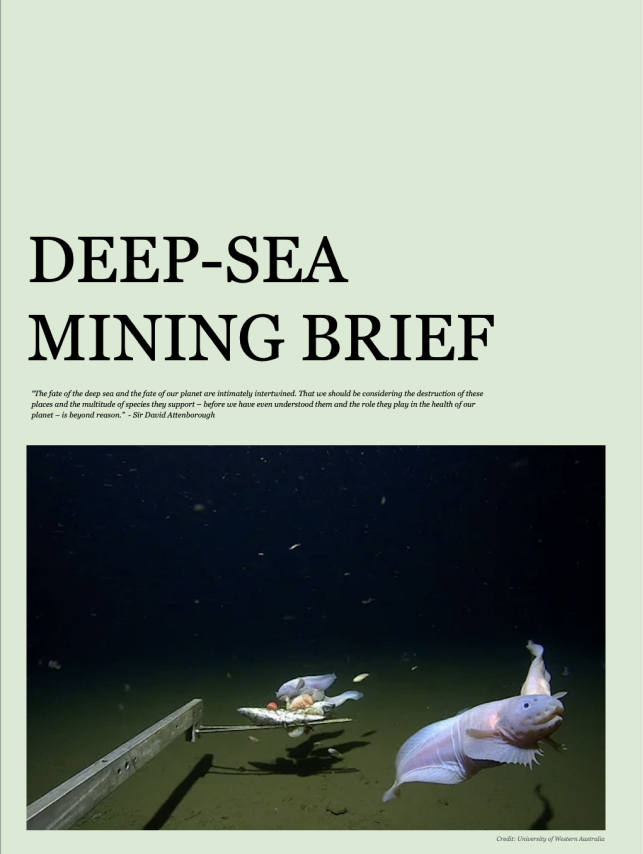
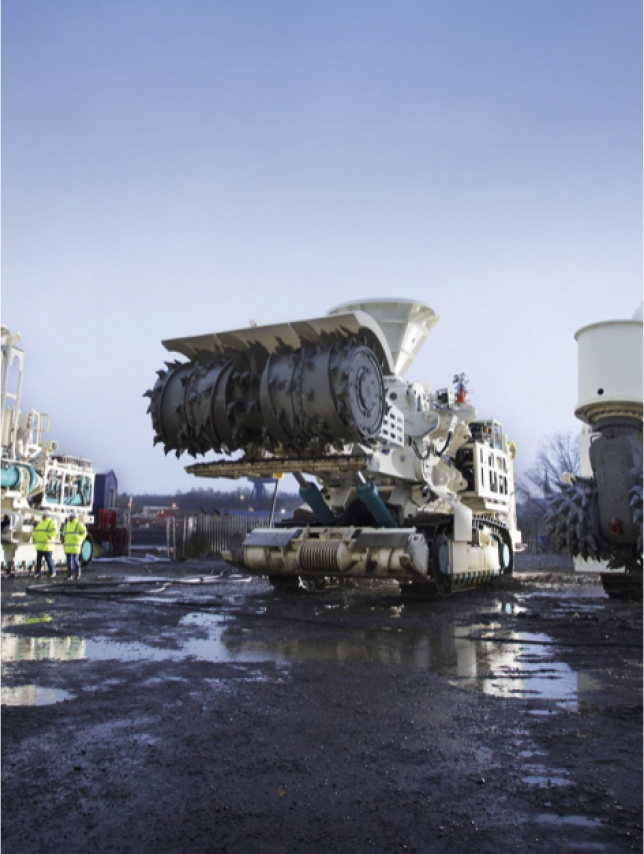
Deep sea mining is the process of extracting mineral deposits, namely rare earth minerals, from the deep sea – the area of the ocean below 200m/600ft, in international waters.
There are 3 habitats of interest:
1. Cobalt rich crusts on Seamounts.
2. Massive sulphides on Hydrothermal vents.
3. Polymetalic nodules in Abyssal plains.
With mounting interest in the prospect of monetizing our global commons, there is pressure for ISA officials to rush to pass the Mining Code – the exploitation regulations that will allow deep seabed mining to take off on an industrial scale. In 2021, the Pacific Island of Nauru, a sponsoring state of the deep-sea mining company, The Metals Company, triggered a rule known as the “two-year rule.” This rule is intended to fast-track the adoption of seabed mining regulations. It allows for a mining plan to be approved after two years with or without environmental protections or regulations in place.
Interest in mining the deep-seabed is under the guise of fueling the green energy revolution. Deep-seabed mining as a climate solution is an oxymoron. The deep sea creates the climate we enjoy and rely on for survival, by ocean currents propelled by upwelling from the deep sea. It is also critical for the ocean food web, which coastal communities also rely on for food sovereignty, culture & economies. In 1990, 50% of total global population lived within 200 km of a coastline at the time of analysis, with over two-thirds of the population within 400 km of a coastline; and by 2025 70% would live within 200 km of the coastline and over 3 billion people worldwide rely on food from the ocean as a significant source of animal protein. The deep-sea is one of the largest carbon sinks and is important longterm carbon sequestration.
If permitted, deep-sea mining could irreversibly impact the oceans’ role in climate stability, biodiversity and economies.
This practice poses significant risks to the health of our oceans and the delicate ecosystems that depend on them. The deep sea is a fragile and largely unexplored ecosystem, and we simply don’t know enough about it to understand the long-term impacts of deep sea mining. What we do know is that mining operations can disrupt the seabed and release sediment plumes that can smother and harm marine life, destroying habitats that can take decades or even centuries to recover.
In addition to the environmental risks, deep sea mining also poses a threat to human communities and livelihoods. Many of the areas being targeted for mining are home to vulnerable communities who rely on the ocean for food and income. The impact of deep sea mining on these communities is not yet fully understood, but it’s clear that they could be negatively impacted by the disruption of traditional fishing and other activities.
The ISA, or United Nations International Seabed Authority, is an autonomous governing body that has jurisdiction over 50% of the Earth’s surface found in international waters. The ISA has already awarded 31 exploration licenses in the deep-sea, which, if allowed to begin, will kick off the largest mining operation in history, totaling 1.5 million square km, an area greater than two times the size of France.
One of the primary issues is that the ISA has an inherent conflict of interest as both the profiteer and the steward of the deep sea. They are meant to both oversee and regulate mining practices in this area and also to protect this area from environmental harm. The ISA’s Secretary-General, Michael Lodge, said, “Once you have mining, you have monitoring, then you can develop standards, and you can progressively tighten those standards once you have a feedback loop from monitoring your activity.” Leadership in the ISA is prioritizing the launch of a new global industry and is looking for ways to circumvent rather than prioritize their mandate to create environmental standards.
The mining industry has created a false dichotomy that we have to choose between land mining or deep sea mining. In reality, it’s not either land mining or deep sea mining: its land mining AND deep sea mining. Deep-sea mining will simply be an extension of already harmful mining practices into new out of sight and out of mind depths.
The good news is, we don’t need deep-sea mining. We need less minerals than we think: we can reduce demand by 58% from now to 2050 with new technology, adopting circular economy models and recycling.
New technology can reduce demand by 30%. Many new breakthroughs are reducing and replacing minerals. Examples of this are Lithium Iron Phosphate batteries: no nickel, cobalt or manganese & they’re already in production with companies like Tesla. Other EV producers like BYD, Ford and Volkswagen not far behind in incorporating this technology. Samsung and Panasonic are also designing out cobalt. Other battery companies like Enercap and MaterialsX are replacing minerals. Hydrogen fuel cell technology has advanced to provide energy from the most abundant molecule, hydrogen.
Circular economy models can reduce demand by 18%. This means using minerals we already have. This could look like, improving products life span, reducing demand for minerals and urban mining.
By recycling better, we can reduce demand by another 10%. Recycling minerals could replace extracted ones in the long-term creating the circular economy. To do this, we need new designs, minerals should be easier to remove from end-of-life products & improvement in the technologies recovering those minerals is needed. As of today less than 20% of e-waste is recycled, we can and must do better than that.
Several companies, organizations, and countries have come out against deep sea mining.
Big companies, including BMW, Google , Patagonia, Samsung, Volkswagen and Volvo have made a public call for a moratorium on the practice.
14 countries have now taken positions against deep-sea mining in international waters: Palau, Fiji, Federated States of Micronesia, Samoa, New Zealand, Germany, Costa Rica, Chile, Spain, Panama, Ecuador, Vanuatu, the Dominican Republic, and France.
Key Signatories:
Sylvia Earle – Explorer, Biologist, Environmentalist
Jane Fonda – Actress, Activist, Environmentalist
Robert Redford – Actor, Filmmaker
Ted Turner – Founder, CNN, TBS, and UN Foundation
HM Queen Noor Al Hussein – Queen Dowager of Jordan
Jackson Browne – Rock & Roll Hall of Fame Inductee
Bertrand Piccard – Explorer, Chair of the Solar Impulse Foundation
Sven Lindblad – CEO, Lindblad Expeditions
Gerry Lopez – Surfer, Actor, Yogi
Graeme Kelleher – Former Chairman and CEO, Great Barrier Reef Marine Park Authority
David Shaw – Managing Partner, Blackpoint Group LP
Robert Weir – Founding Member, Grateful Dead
Wade Davis – Writer, Explorer, Photographer, Filmmaker
Tom Gruber – Co-founder of Siri
Frederick Paulson – CEO, Ferring Pharmaceuticals
M. Sanjayan – CEO, Conservation International
Pirry – Director, Journalist, Environmentalist
Michael Jacobs – Sustainability & Social Innovation Leader, IBM
Jonathan Batty – Director of Public Relations, IBM
Pierre Ramadier – Global Head of Entrepreneurs & Families, BNPP
Pierre Rousseau – Senior Executive Manager, BNPP
Erin Urquhart – Associate Program Manager, NASA
Oliver Steeds – Journalist, Broadcaster
Jay Inslee – Governor of Washington
Esha Gupta – Actress, Model, Environmentalist
Shawn Heinrichs – Photographer, Filmmaker, Environmentalist
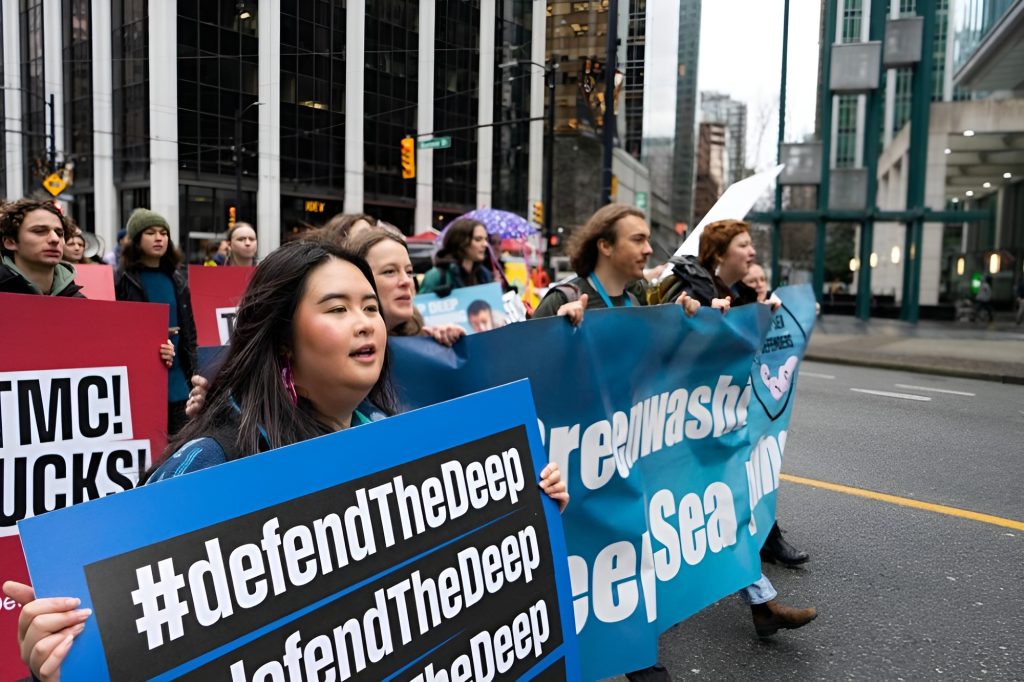
The Oxygen Project is a proud member of The Deep Sea Conservation Coalition (DSCC), an alliance of over 100 international NGOs and environmental organizations banding together to #DefendTheDeep.